

Meet the Black Composers: Bologne
JOSEPH BOLOGNE CHEVALIER DE SAINT-GEORGES
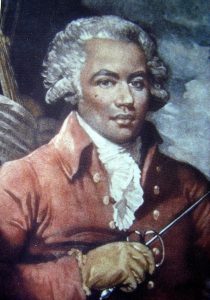
The Caribbean islands were notorious for their cruel and dehumanizing treatment of enslaved peoples during the transatlantic slave trade (which lasted from the 16th-19th centuries and continues to bear weight on our lives today). One small island in the French occupied West Indies was the birthplace of a man who grew to become a truly renaissance creative, athlete, and political leader in France.
Born around 1745 on the island of Guadalupe, Joseph Bologne Chevalier de Saint-Georges spent his early childhood as an enslaved person living under the harsh rule of the Code Noir. At around the age of 10, Joseph’s father, a white nobleman and plantation owner by the name of George de Bologne de Saint-Georges, fled the island and settled in France. With him George brought the young Joseph, his enslaved Senegalese mistress (Joseph’s mother Anne Nanon), and his own legitimate wife and child. The move would prove life changing for the young Joseph Bologne.
In France, Joseph was exposed to high aristocratic living and culture. He learned about religion, languages including Latin and German, social sciences, history, and the arts by attending school. He picked up fencing – known as a gentleman’s sport – when he was 13 and became a champion fencer. He studied violin, was a virtuoso soloist, and served as concertmaster for the Concert des Amateurs, one of the most rebuttable orchestras in Paris at the time. Composers like Carl Stamitz and Francios-Joseph Gossec (who was also one of his teachers) wrote works for him.
As was typical of musicians of the time, Joseph composed many works for himself to perform including violin sonatas, concertos, symphonies, and chamber works that very much featured the violin and the technical skills of the performer. He also wrote operas, pioneered a new compositional style known as the sinfonia concertante, and was one of the first French composers to write for the string quartet. As a conductor, he commissioned Joseph Haydn to write his six Paris Symphonies and was nominated to be the Director of the Paris Opera, an opportunity that was later rescinded due to a racially charged petition that sabotaged his chances. If that weren’t enough, he also led an all Black army during the French Revolution, a long and bloody turmoil that led to the rise of Napoleon Bonaparte.
For a man of such talents, his name and legacy should be more widely known! While many factors contributed to his disappearance, a ban on his music placed by Napoleon effectively wiped his memory from concert stages and history books for centuries. It would be about 130 years following Joseph’s death in 1799 – ironically the same year Napoleon took rule – before a string quartet by a Black composer, the African American Clarence Cameron White, would be performed in Paris on May 29, 1931. Take a listen to Joseph Bolonge Chevalier de Saint-Georges’ Symphony in G Major HERE.
